

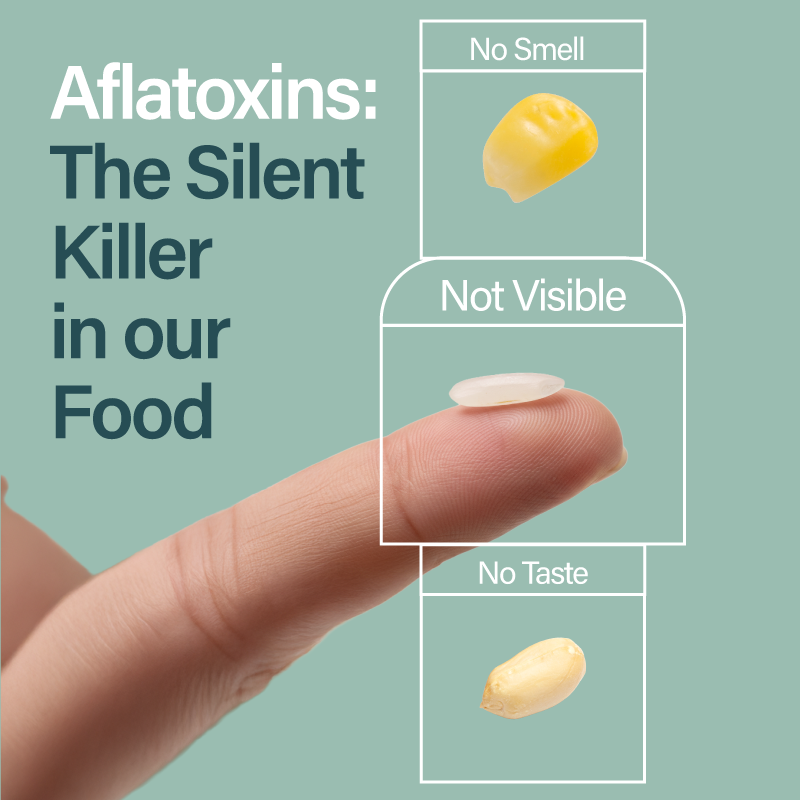
Imagine taking a bite into your favourite foods, savouring them, all while not knowing there could be poison hiding inside. That poison is called aflatoxin, which is a dangerous chemical produced by certain molds that grow on food. The thing is: It has no smell or taste, and we have no way of knowing if it’s on the food that we’re eating, as its not visible to the naked eye. However, there are many ways we can avoid them and decrease their levels within our bodies – drinking probiotics daily is one of them.
What are Aflatoxins?
Aflatoxins are harmful chemicals released by mold like Aspergillus flavus and A.parasiticus that commonly grow on crops and food items when the environment is warm and humid.1,2 According to the International Agency for Research on Cancer,3 aflatoxins are officially classified as Group 1 carcinogens that increase the risk of cancer in our bodies.
Where can Aflatoxins be Found?
Mold thrives under warm and humid environments, therefore making aflatoxin contamination more common in Malaysia than we think. Here is a list of local staple foods where contamination may be typically detected:
| Where? | How? |
|---|---|
| Peanuts | Raw peanuts and peanut products (candy, snacks etc.) are food items found to have the highest level of aflatoxins in Malaysia, with up to 1000 µg/kg.4,5 |
| Spices | Chilli products and spices, like pepper, are found to have high levels of aflatoxins due to improper storage and processing methods that introduce aflatoxins.4,5 |
| Rice | Rice and rice flour are found to have small amounts of aflatoxins.4 |
| Soybean/corn/sunflower oil | Aflatoxins enter these edible oils when the raw products are processed into oil.4 |
That’s not all! Meat and animal-products like eggs can also sometimes contain aflatoxins. When livestock eat animal feed like grains, legumes, and corn that are contaminated, they go into our food as well.


How Do Aflatoxins Harm Us?
According to the Ministry of Health Malaysia, aflatoxins are linked to liver cancer and severe food poisoning, known as aflatoxicosis6. Aflatoxicosis can be further categorized into acute and chronic toxicity: Acute toxicity results from short-term exposure to high doses, with symptoms typically lasting a few days to weeks. In contrast, chronic toxicity develops slowly through long-term ingestion of aflatoxins in small amounts.7 Typically, chronic aflatoxicosis is more common than acute poisoning because people are more often exposed to small, repeated amounts in contaminated staple foods, whereas high-dose exposures are relatively rare.8 The symptoms and outcomes of acute and chronic toxicity are outlined below:
| Acute Aflatoxicosis | Chronic Aflatoxicosis |
|---|---|
| Yellowing of skin and eyes (jaundice) | Liver cancer |
| Nausea | Hepatitis A/B/C/D/E |
| Vomiting | Autoimmune diseases |
| Lethargy | Impaired growth and development |
Did you know? Southeast Asia carries some of the highest aflatoxin-related cancer risks globally, alongside sub-Saharan Africa and China.9 In Malaysia, dietary exposure to aflatoxins are relatively higher than other Asian countries, ranging from 0.002 – 34.00 ng/kg body weight per day. Nevertheless, the national risk of aflatoxin-related cancer remains low, whereby it is estimated at fewer than one liver cancer case per 100,000 people each year.5 However, it is still crucial for consumers to stay aware of aflatoxin contamination in food, as it remains a concerning food-safety issue.
The Journey of Aflatoxins


How to Reduce Aflatoxin Intake?
- Having a balanced diet
-
- Utilize the Malaysian Food Pyramid and Malaysian Healthy Plate as a guide to healthy eating
- Incorporating a variety of fruits and vegetables that are high in antioxidants which strengthens our immune system, protecting us against the harmful effects of aflatoxins
- Proper storage of dry foods
- Store spices, rice, beans and dry products in airtight containers
- Select products mindfully
- Buy products from trusted brands that have food safety certifications
- Always check product expiry and best before dates
- Thorough cooking
- Cooking at high temperature can reduce aflatoxins in our food,10but it is important to note that it does not completely remove them
- Do not consume foods that are mouldy, smells strange, or past the expiration date
- Daily probiotic intake
- Probiotics like Lacticaseibacillus paracasei Shirota strain found in Yakult can help remove aflatoxins from our body, as aflatoxins bind to this probiotic are naturally excreted through feces


Probiotics are Proven to Lower Aflatoxins in our Bodies
Based on a recent study conducted by Universiti Putra Malaya (UPM) in collaboration with Yakult Honsha Co., Ltd. (Japan), 174 healthy Malaysian adults were tested for 12 weeks to observe changes in aflatoxin content after taking probiotics. Half of them drank two bottles of Yakult daily, while the other half drank a similar-tasting milk (placebo) without Shirota strain in it.
Results after 12 weeks showed that the adults that drank Yakult every day had 23% less aflatoxin in their urine than adults that drank the placebo, proving that the probiotics in Yakult effectively gets rid of aflatoxins in our body. Additionally, this study emphasizes the importance of daily probiotic intake as consistent consumption further reduces aflatoxins levels, while discontinuing intake eliminates this benefit.11
Putting it into context:
To maintain a strong gut that can provide some protection against aflatoxins, daily probiotic intake is essential! Think of it like body building or sports performance, where working out or training consistently is key.
How it works:
When aflatoxins reach the small intestines, up to 98% can bind to the probiotic in Yakult, called the Shirota strain. Once bound, the aflatoxins are prevented from being absorbed into the bloodstream and are excreted out the body through feces. Although the binding is not 100%, it significantly reduces the amount of aflatoxin that enters the blood, hence reducing exposure inside the body and lowers risk of related symptoms. With aflatoxins being excreted through feces, the levels in urine will also gradually decrease.


Packed with 30 billion of live Shirota strain per bottle, drinking Yakult daily is an easy and tasty way to help our body get rid of aflatoxins. Not only that, Yakult helps strengthen the gut where 80% of our immunity lies, maintains a balanced gut microflora, improves digestion, and reduces toxins in our body. With that, jom minum Yakult setiap hari!
Note: Yakult doesn’t remove aflatoxin from food. Instead, it helps your body get rid of them after they have been consumed from contaminated food.
References
- Coppock RW, Christian RG. Aflatoxins. Veterinary toxicology. 4th Academic Press; 2025:1009-1023. https://doi.org/10.1016/B978-0-443-29007-7.00043-1
- National Cancer Institute. Aflatoxins. Updated July 3, 2025. Accessed November 17, 2025. https://www.cancer.gov/about-cancer/causes-prevention/risk/substances/aflatoxins#:~:text=The%20main%20fungi%20that%20produce,at%20harvest%2C%20and%20during%20storage.
- IARC Working Group on the Evaluation of Carcinogenic Risks to Humans. Some Traditional Herbal Medicines, Some Mycotoxins, Naphthalene and Styrene. Lyon (FR): International Agency for Research on Cancer; 2002.
- Ali N. Aflatoxins in Malaysian food. JSM Mycotoxins, 2000;50(1):31-35.doi:10.2520/myco1975.50.31
- Chang WL, Saad HA, Jamaluddin R, Sabran MR. Aflatoxin occurrence, food regulations, dietary exposure, and risk assessment: A mini review from the Malaysian perspective. Mal J Med Health Sci. 2023;19(1):296-306.Accessed November 17, 2025. https://medic.upm.edu.my/upload/dokumen/2023011614435637_MJMHS_0392.pdf
- Kementerian Kesihatan Malaysia. Aflatoksin. Program Keselamatan dan Kualiti Makanan. 2023. Accessed November 17, 2025. https://hq.moh.gov.my/fsq/aflatoksin
- Dhakal A, Hashmi MF, Sbar E. Aflatoxin Toxicity. In: StatPearls [Internet]. Treasure Island (FL): StatPearls Publishing; 2025. Accessed November 17, 2025. https://www.ncbi.nlm.nih.gov/books/NBK557781/
- Gong YY, Watson S, Routledge MN. Aflatoxin exposure and associated human health effects, a review of epidemiological studies. Food Saf (Tokyo).2016;4(1):14-27. doi:10.14252/foodsafetyfscj.2015026
- Liu Y, Wu F. Global burden of aflatoxin-induced hepatocellular carcinoma: A risk assessment. Environ Health Perspect,2010;118(6):818-824. doi:10.1289/ehp.0901388
- Romero-Sánchez I, Gracia-Lor E, Madrid-Albarrán Y. Aflatoxin detoxification by thermal cooking treatment and evaluation of in vitro bioaccessibility from white and brown rice. Food Chem, 2024;436:137738. doi:10.1016/j.foodchem.2023.137738
- Chang WL, Akiyama T, Wang JS, et al. Impact of probiotic Lacticaseibacillus paracaseistrain Shirota (LcS) on aflatoxin exposure among healthy Malaysian adults: A randomized, double-blind, placebo-controlled intervention study. J Nutr, 2025;115(7):2110-2121. doi:10.1016/j.tjnut.2025.04.014